SOCIAL ENTREPRENEURS' ETHICS PLAYBOOK
  • Home
  • About
  • Good Goods
  • Good Work
  • Good Wealth
  • Case studies
  • other resources
  • Contact

The social entrepreneur's ethics playbook

​Over​ 30 Tools
17 videos
9 case studies
6 links to more resources
This playbook does not insist that we must be perfectly ethical.  We are all "compromised" by life.  This is not a checklist for virtue.  This is a resource that you can freely use to improve the ethical practices of the social enterprises with whom you work.

All entrepreneurs use social resources and the commons. This playbook is for you if you want to avoid being an anti-social entrepreneur.

Good Goods

 Good Work

 Good Wealth ​

I have used Mcvea & Naughton's concept of Good goods, Good work and, Good wealth to structure this website: McVea, John F., and Michael J. Naughton. 2021. Enriching Social Entrepreneurship from the Perspective of Catholic Social Teaching. Religions 12: 173. https://doi.org/10.3390/rel12030173

Exploring the ethical landscape


We all co-produce an ethical landscape in the social situation of which we are members.  This landscape may at times be very dark with little light.  At other times you may find yourself in a situation whose ethical landscape is exposed to the full glare of the public.
Allowing yourself, and the colleagues with whom you are working, the space to explore the ethical landscape of the situation you are in, should be done in a manner that is as safe as possible.  This will afford you and your team the opportunity to explore freely and engage in dialogue about the issues without accusation or hasty judgement.  
The Social Enterprise Toolbox provides some great resources to promote dialogue. Click on the button below to get these tools:  
Dialogue tools
Picture

A   Lasting   Journey

Have you noticed that so many people and projects that claim to be doing good, fail to achieve their claims?  As social enterpreneurs we need to be careful about assuming we are doing good.  The road to hell is paved with good intentions.

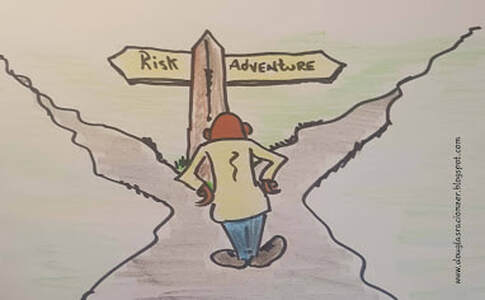
When we start to think ethically, it's a bit like going on a journey.  Paths need to be chosen without any clear outcome in view.  Over many centuries, some of the wisest of us have developed ideas around what is a good path to follow.  Listening and reading their thoughts on the Good helps but really it's up to you to choose a path and, then to walk down that path.  Not choosing, means that others with their own agendas, will choose for you.  

There is really nothing for it but to think ethically about what you do, especially if you claim to be doing good!

A good tool for making ethical decisions has been developed by Ollie Williams, a well known ethicist. To look at it, click on the link below.
making_ethical_decisions.pptx
File Size: 32 kb
File Type: pptx
Download File

A Social Mission is not enough


In 2020, a really useful academic paper on the ethics of social enterpreneurship was published in the Journal of Business Ethics:  A Social Mission is Not Enough: Reflecting the Normative Foundations of Social Entrepreneurship
Written by Ignas Bruder, this paper offers a telling critique of social entrepreneuership's ethical claims.  Click on the button below to access the paper.
A social mission is not enough...

Planet & Climate

In 2021 we are facing an ecological crisis of planetary proportions.  Ashoka has published a truly groundbreaking integration of the insights and work of 191 globally recognised social enterpreneurs working to tackle this crisis.  Compiled by Alexandra Ioan, PhD, Head of the Ashoka Learning and Action Center Pip Wheaton, Global Co-Leader of Next Now: Planet & Climate Irene Wu, Director of Knowledge, Next Now and, Claire Heiden, Research assistant, Next Now. 
​This report is well worth reading and incorporating into your organisational strategy.  Get the report by clicking on the button below.
Ashoka report on Planet and Climate 2021

All enterprises are social enterprises


There has been an ongoing concern that social enterprises and social entrepreneurship lacks definition.  When thinking about social enterprise through an ethics lens, some clarity is possible though. Below is a paper published in 2012.  Check it out: 
https://unboundedorganization.org/wp-content/uploads/2014/12/All-Entrepreneurhsip-is-social.pdf

In this article (Just over 11 pages), the argument is that there are 4 clearly identifiable types of social enterprise defined by understanding their contribution to our social life.  Click on the button below for a brief overview.
All entrepreneurship is social entrepreneurship
The ladder of participation and public participation
Picture
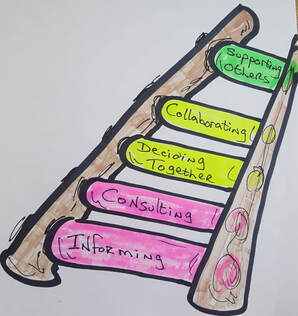
One of the key strengths of working for the common good is that we have the public on our side!  Leverage the advantage you have by working with the public, instead of trying to sell them something?

Back in the 1969, Arnstein introduced the ladder of participation for organisations to benchmark where they are in working with the public.
A more detailed paper on public particiapation which you may find useful can be found if click on the button below.
In 2005, Gene Rowe and Lynn J. Frewer published a good typology which you may find helpful
a_typology_of_public_engagement_mechanis.pdf
File Size: 211 kb
File Type: pdf
Download File

Public participation
A values letter
Many people from different culutues with differing identities cannot be expected to share the same values.  This is why getting people with whom we work to agree a set of values at the beginning of a relationship helps set the tone and provides a moral basis for social enterpreeusr to relate to each other.  Here is an example of a values letter that is in use amongst networks of social enterpreneurs. 
values_letter.docx
File Size: 27 kb
File Type: docx
Download File

Powered by Create your own unique website with customizable templates.
  • Home
  • About
  • Good Goods
  • Good Work
  • Good Wealth
  • Case studies
  • other resources
  • Contact